
Massive cuts to Medicaid now being rolled out following passage of the Federal “One Big Beautiful Bill Act (H.R. 1)” last July are expected to increase the number of uninsured residents and further strain the Wellspan Gettysburg Hospital, experts warned last night during a community forum at St. James Lutheran Church. The cuts will particularly hurt seniors.
The law, which will be in full effect by January, requires many Medicaid recipients to meet new work or community engagement requirements and undergo more frequent eligibility verification and reporting, while also restricting automatic renewals and changing enrollment procedures. It reduces federal Medicaid spending and includes provisions affecting coverage purchased through Pennie, Pennsylvania’s state-run healthcare exchange.
Robin Stelly, a statewide organizer with the Pennsylvania Health Access Network, said that unless the provisions of the bill changed in the near future, Medicaid work and reporting requirements, increased paperwork, and changes to marketplace insurance enrollment will cause many Pennsylvanians to lose health coverage.
“Medicaid is the most powerful public health intervention ever. It’s more powerful than Medicare. People mention Medicare always, but Medicaid covers more people. It’s involved with people from cradle to the grave,” said Stelly.
“It’s just punishment, punishment, punishment,” Stelly said, arguing that many people who lose coverage will do so because of administrative barriers rather than because they no longer qualify for assistance.
Stelly noted that most adults receiving Medicaid already work and challenged the notion that additional work requirements will increase employment. “I don’t work to get Medicaid. I have Medicaid so I can work,” she said, recalling the words of a Medicaid recipient.
According to estimates presented during the forum, approximately 18,000 residents in Pennsylvania’s 13th Congressional District could lose Medicaid coverage and another 15,000 could lose marketplace insurance coverage.
Stelly said the consequences would extend far beyond those individuals, warning that hospitals could face an estimated $40 million increase in uncompensated care costs across the district, while medical debt, job losses, and preventable deaths would also rise.
Stelly noted the recent closing of Bradford County’s Regional Medical Center, including its inpatient unit and emergency department, as an example of financial pressures that local officials linked in part to broader healthcare funding concerns. “Hospitals are nervous about this — very nervous about this,” she said.
The cuts come at a time when state hospitals are already overcrowded. Gettsyburg Wellspan Hospital is no exception, already operating at over 100 percent capacity for extended periods of time.
The concerns come as Adams County already faces growing healthcare demands from an aging population. Lynn Deardorff, executive director of the Adams County Office for Aging, said more than one-fifth of county residents are age 65 or older and many are struggling with rising healthcare costs.
Deardorff described the case of a 61-year-old Adams County woman who recently suffered two strokes and now requires around-the-clock nursing home care. Because she is not yet eligible for Medicare and receives insurance through her husband’s employer-sponsored plan, the family faces a complicated path to obtaining long-term care assistance through Medicaid.
“This is happening right here in Adams County,” Deardorff said.
She also described seniors choosing between medications, groceries, utility bills, and personal care supplies. One resident, she said, opted to purchase medication rather than needed incontinence supplies, a decision that can lead to serious health complications and costly hospitalizations.
The Adams County Office for Aging now maintains waiting lists for some services as demand continues to grow, Deardorff said. She noted that many older residents see Social Security increases offset by rising Medicare costs, housing expenses, and reductions in other benefits.
Andy Winebrenner, community services director for the Adams County Office for Aging, said affordability has become one of the biggest concerns facing seniors. Many older adults spend thousands of dollars annually on premiums, prescription drug plans, supplemental coverage, and out-of-pocket medical costs.
“We have so many people that are just above the Medicaid level,” Winebrenner said. “When you talk about thousands of dollars of healthcare costs when you’re living on $24,600 per year, it’s very challenging.”
Winebrenner said many seniors are delaying doctor visits, avoiding specialists, or declining recommended treatments because they cannot afford the costs. Others are considering dropping supplemental insurance plans because premiums have risen beyond what they can manage on fixed incomes.
“We hear people say they simply cannot afford to go to the doctor,” he said.
Local healthcare advocate Will Lane said the challenges discussed during the forum point to larger questions about the values that guide public policy. He called for greater transparency in healthcare pricing, accountability within healthcare systems, and broader access to affordable care.
Lane noted the many county residents who demonstrate compassion through volunteer work, charitable organizations, and community service, but said those same values should inform public policy decisions.
“The question is how do we get to understand ourselves as a larger community that is ready to take care of our neighbors,” Lane said.
Lane suggested that discussions about healthcare should focus less on political divisions and more on shared community and religious values, including human dignity and fairness.
The forum, sponsored by Gettysburg Area DFA, concluded with a discussion of local healthcare needs and findings from a recent WellSpan community health assessment, which identified affordability, access to care, and the county’s aging population among the most significant healthcare issues facing Adams County.
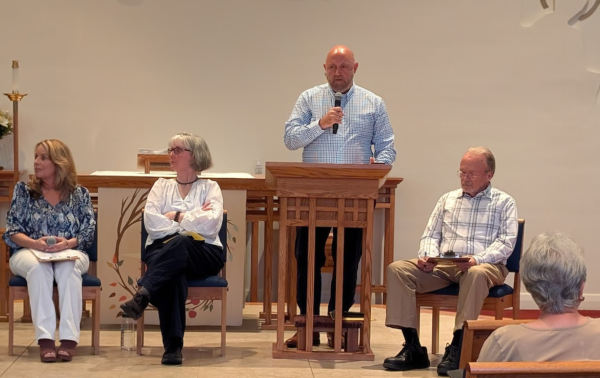
Featured image caption: Deardorff, Skelly, Winebrenner, and Lane.

The Republican Party explicitly said it would do this during the last Presidential election. Words like “root out waste, fraud, and abuse” were coy coverups of the real intent to hugely scale back America’s social safety nets by forcing Americans off coverage and by cutting funds available overall for these programs.
Yet Pennsylvania overwhelmingly voted Republican anyway.
I sympathize at the losses in coverage; however, anyone who voted Republican, thinking, “rooting out waste, fraud, and abuse is a good thing, and Republicans will never hurt me” needs to wake up and smell the coffee.
You are getting what you voted for.
Agreed. Interesting how “draining the swamp” turned into what we have today – weekly pardons for financial criminals, and severe bending of rules and laws to benefit the same “swamp” while people struggle even worse than before. And none of this should be surprising to anyone.