

By the time the Founders gathered in Philadelphia in 1787 for what became the Constitutional Convention, Virginia planter and legislator James Madison had already demonstrated his abilities as a legislator by steering Jefferson’s Virginia Statute of Religious Freedom through the Virginia legislature. The Constitutional Convention would challenge these skills to the utmost.
Madison famously had read every work ever written on political philosophy and had studied every known form of government. Like most of the Founders, he had developed an abhorrence for direct democracy as represented by Golden Age Athens, which he considered mob rule, a danger to the rights of minorities, and believed inevitably led to either anarchy or tyranny. Madison also admired greatly the Roman Republic, which carefully balanced power and lasted 500 years. His concern was how to create the strengths of the Roman Republic while avoiding the descent into tyranny that led to its end. He also drew heavily on the ideas of Enlightenment philosophers such as John Locke, the Baron de Montesquieu, Rousseau, and Voltaire.
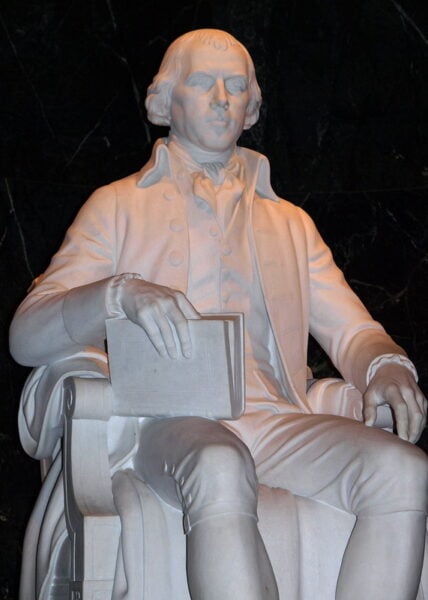
He came to the Constitutional Convention with a design, which came to be known as “The Virginia Plan.” It called for a chief executive and a unicameral legislature, with each state’s representation to be determined by population. Madison’s design was a careful balance, trying not only to anticipate political opposition but also to create a strong government while avoiding the likelihood of tyranny. The main instruments he chose were “separation of powers,” “checks and balances,” and Federalism. His idea was to recognize that people are ambitious and use this ambition as a source of stability. If power was divided within the Federal government, and between the Federal government and the States, Madison reasoned, men could be relied on to defend their “turf,” which would help protect against tyranny. Congressional power would act as a check on the president and State power would limit the propensity for Federal over-reach.
There were three major sources of disagreement among delegates. First was the division between those who agreed that it was necessary to establish a strong federal government and those with a wide variety of views opposing a strong federal government. Some believed the Convention should keep the Articles of Confederation, which established a “firm league of friendship” but left the states with their full “sovereignty, freedom, and independence,” perhaps with some tweaks. Others recognized the need for some sort of central authority to “provide for the common defense.” Yet others objected less to the idea of a central government than they did to a strong Executive at its head, fearing a return to the tyranny they had rebelled against.
The second divide was between small and large states. In the 1790 Census, the smallest seven states (a majority) contained barely ¼ of the population, fewer than the largest two. Small states feared they would be dominated by a few large states (half the population lived in only four) while large states feared that they could be dominated by a coalition of small states representing a small fraction of the population.
The third divide, which turned out to be the biggest challenge to the Constitution and in future decades would come to dominate American politics, was the divide between states where slavery was permitted and those where it was already banned or on the way toward an end.
The population was roughly equally divided at this point (if enslaved persons were counted) but anyone could see non-slave Vermont lined up to join along with Kentucky and Tennessee while people were already pouring into the Northwest Territory, where slavery was banned in legislation passed while the Constitutional Convention was meeting. This dispute was the most intractable because the grounds for compromise were far more limited. If southern slaveowners perceived their interests were being threatened, they would just walk away. The framers made several key concessions to the slave states, which will be discussed in a later article.
The Constitution and the Limits of Democracy. The Constitution established the first true Federal government in the United States. Emphatically, it did not establish a “democracy,” or anything close. The “Father of the Constitution,” James Madison, regarded democracies as tyrannies of the majority, a threat to property and almost guaranteed to trample the rights of minorities. He wrote that democracies “have ever been spectacles of turbulence and contention; have ever been found incompatible with personal security or the rights of property.”
The selection of government officials for the most part was insulated from even the very limited democratic processes that existed at the time. Members of the Judiciary were appointed and didn’t face voters at all. The president was selected by a committee of leading citizens (the Electoral College). As designed, the popular vote, where it was used at all, was only advisory. And in fact, in the first election (1788), only four states (Delaware, Maryland, Virginia, and Pennsylvania) even chose their electors through popular vote. The legislatures of two other states (New Hampshire and Massachusetts) chose electors based on the popular vote. But no popular vote at all was held in four states. The New Jersey governor and Council selected that state’s electors while the legislatures chose the electors in Georgia, South Carolina, and Connecticut. (New York was unable to agree on a process and didn’t vote, while North Carolina and Rhode Island hadn’t yet ratified the Constitution.)
One branch of the legislature – the Senate – was selected by State legislatures; of all branches of the federal government, only the House of Representatives was elected by the voters. And, at the time, “the voters” was itself a small, select group: in most states, white, male property owners over 21 years of age.
The creation of a Constitutional by definition limits the ability of a majority to rule. Once in office, a variety of constitutional requirements limited majority rule. For example, a majority in Congress is prohibited from passing a bill of attainder – a legislative declaration that a person is guilty of a crime – or an ex post facto law – a declaration that some event committed in the past, legal at the time, is now a crime. No religious test for federal office is permitted. Habeas corpus cannot be suspended except during a rebellion. Congress can’t grant and Americans can’t accept titles of nobility. Similarly, the Bill of Rights outright prohibited a majority from passing a law establishing an official religion, preventing the free exercise of religion, limiting rights to petition the government, abridging freedom of the press, etc. Congress was prohibited from banning the slave trade for a period of 20 years. And while the Framers allowed amendments, the process required a super-majority in both Houses of Congress AND of the states.
The Framers intended to create a stronger Federal government. Yet they remained terrified of both mob rule and tyranny. This required a careful balance of limits on the president’s power and limits on the ability of the legislature to impose majority rule.

Thank you, Leon. This is a very good article and one that everybody should read.