

By the mid-1700s, the ideas of the Enlightenment – social contract, natural rights, freedom of speech, religious toleration – had been in circulation for nearly 100 years. But the Declaration of Independence was the first time these thoughts had been translated into action. Within a few months of its adoption by the Continental Congress, the Declaration had spread throughout Europe. In Spanish-America, publication and circulation of the Declaration and other revolutionary documents was banned, but it was still translated into Spanish and continued to spread.
Veterans of the Revolution also spread the word. Tadeusz Kosciusko is a national hero in Poland for his efforts to promote human liberties and the end of feudal practices in that country. With the help of America’s ambassador to France, Thomas Jefferson, the Marquis de Lafayette drafted the Declaration of the Rights of Man and of the Citizen, which was eventually approved by the French National Assembly and King Louis XVI. The two “Declarations” were read throughout the world and inspired independence movements.
These independence movements took many forms. In many countries including much of Latin America, they amounted to revolts of the aristocracy against the monarchy, with the result of substituting one ruling class for another. In others, including Haiti and Mexico, they were revolts of the peasant class that called for structural as well as governmental reforms. Although the Declaration of Independence didn’t inspire its authors to end slavery in their own territory, it did inspire other anti-slavery movements. In many countries, the rebellion was accompanied – or led – by a movement to ban slavery.
Not all of these movements met with complete success. The most dramatic anti-monarchy (and anti-slavery) movement was the French Revolution, which started in 1789 and led to the overthrow of the French Monarchy. Although it began with idealistic motives and led to a period of democratic reform, the French Revolution eventually hit the trifecta of anarchy, dictatorship, and restored monarchy. During its early stages, the ruling National Convention did abolish slavery in France and its territories. Democratic and anti-monarchy movements in Europe were set back for a time by the 1815 Congress of Vienna, assembled in the aftermath of Napoleon’s downfall to restore stability and establish a tenuous balance of power.
Revolution first spread to the New World with the Haitian Revolution, which officially began in 1791 when a group of enslaved people launched an attack against the brutal conditions of their enslavement. Under the leadership of François-Dominique Toussaint L’Ouverture, slavery was abolished, but Saint-Domingue remained in the French Empire operating as a sovereign state. But when Napoleon tried to reestablish slavery, the Haitian Revolution evolved into a war for independence. The Haitian Declaration of Independence was adopted, and Haiti was established as the first independent, Black-led republic in the Americas.
The Haitian Revolution also affected events in France. In 1793, Jean-Baptiste Belley, a former slave and a captain during the Haitian Revolution, was elected as the first Black deputy to France’s National Convention. He contributed to the debates that led to France’s 1794 abolition of slavery.
By the 19th century, revolutionary ideas spread through Spanish America despite a ban on the circulation of the Declaration and other revolutionary writings. Independence movements gained momentum when Napoleon’s invasions of the Iberian Peninsula (1807–1808) severely weakened Spain and Portugal. Local Creole elites took advantage of the resulting power vacuum and, citing Enlightenment writings as justification, established their own self-governing juntas.
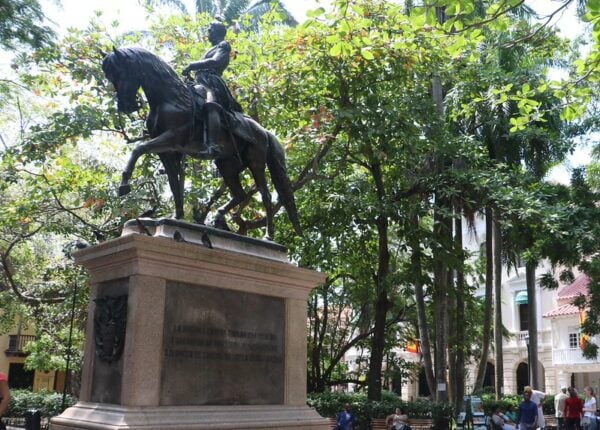
This eventually led to a series of wars of independence led by figures like Simón Bolívar, José de San Martin, and José Artigas. In a few countries, such as Mexico, the independence movements were led by peasants rather than elites. Whatever the cause, these movements managed to throw off the monarchy but otherwise produced mixed results, with many weak, squabbling countries prone to rule by a “man on horseback.”
The vulnerability of these republics led the United States to issue the Monroe Doctrine in 1823, warning European monarchies that the Western Hemisphere was off-limits to re-colonization. The European powers turned their attention elsewhere, racing for influence and colonial possessions in Africa and Asia.
Over the next 100 years, independence and rights movements emerged in European countries, like Austria, Poland, Greece, and Hungary, and in colonies around the world, including India and New Zealand. Liberia also issued the first African Declaration of Independence in 1847, creating an independent republic of Liberia. In the 1848 Declaration of Sentiments, the Seneca Falls Convention adopted the language of the Declaration and its list of grievances to make the argument for women’s rights.
Our own independence movement has been justifiably criticized for its limited application of rights and its failure to deal with slavery. But the ideas of independence, social contract, and natural rights were new and difficult to put in practice. The challenges other countries faced highlight the remarkable accomplishment of our Founders.

Great read. Thanks Leon!